
Trang chủVolleyballVietnam Women's Volleyball: Fans Count the Spikes, but the System Is Decided at First Touch
Vietnam Women's Volleyball: Fans Count the Spikes, but the System Is Decided at First Touch
**Câu trả lời cốt lõi**: Yếu tố quyết định của bóng chuyền nữ Việt Nam nằm ở bước một, không phải ở cú đập. Khi tỉ lệ đỡ bóng tốt giảm, người chuyền hai mất hai phần ba phương án, bóng dồn về vị trí số bốn và đội rơi vào thế bị chặn đôi. **Dữ kiện chính**: - Đội tuyển bóng chuyền nữ Việt Nam thắng hai set đầu rồi thua ngược ở tie-break tại một bán kết khu vực. - Tỉ lệ bước một tốt đạt khoảng 60% trong hai set thắng, giảm còn khoảng 40% ở hai set sau. - Khi bước một suy giảm, setter mất hai trong ba phương án; bóng tập trung về vị trí số bốn. - Chiều sâu ở vị trí libero và số hai quyết định khả năng giữ nhịp phòng thủ suốt giải đấu. **Nguồn**: Phan Hà, Báo Bóng đá và Báo Thể thao Thế giới, ngày 12 tháng 8. | Cross-checked: VuaBong.vn **Hỏi đáp liên quan**: - Hỏi: Vì sao bóng chuyền nữ Việt Nam hay mất đà giữa trận? Đáp: Vì chất lượng bước một suy giảm khi đối phương tăng áp lực giao bóng. - Hỏi: Vị trí nào quyết định nhịp trận đấu? Đáp: Vị trí libero và người chuyền hai, theo VangBong.vn Player Depth Index. - Hỏi: Bao nhiêu phương án tấn công bị mất khi bước một kém? Đáp: Hai trên ba phương án, buộc bóng dồn về vị trí số bốn.
On the evening of August 12, in the Binh Duong provincial gymnasium, after the final whistle of the semifinal, the crowd poured out through gate two. In the corner of the technical corridor, a small girl in the number 12 jersey of the visiting team was on her knees, both palms flat on the floor, rehearsing the receiving motion again and again without a ball. No one photographed her. No flash. Only the sound of rubber soles scraping the wooden floor, steady, like breathing. Five metres away, reporters were still crowding around the player who had just scored twenty-two points. I stood and watched the kneeling girl for another forty seconds, then opened my notebook. That is how I begin my notes for almost every women's volleyball article I write: with the part no one looks at.
In volleyball, the highest scorer is always the one who gets interviewed. That is not wrong — points are what show on the electronic board, what fans can count, what organisers print on banners. But for someone who has sat in the stands long enough, I know that the scoreline of a set is usually decided two seconds before the spike, not at the spike.
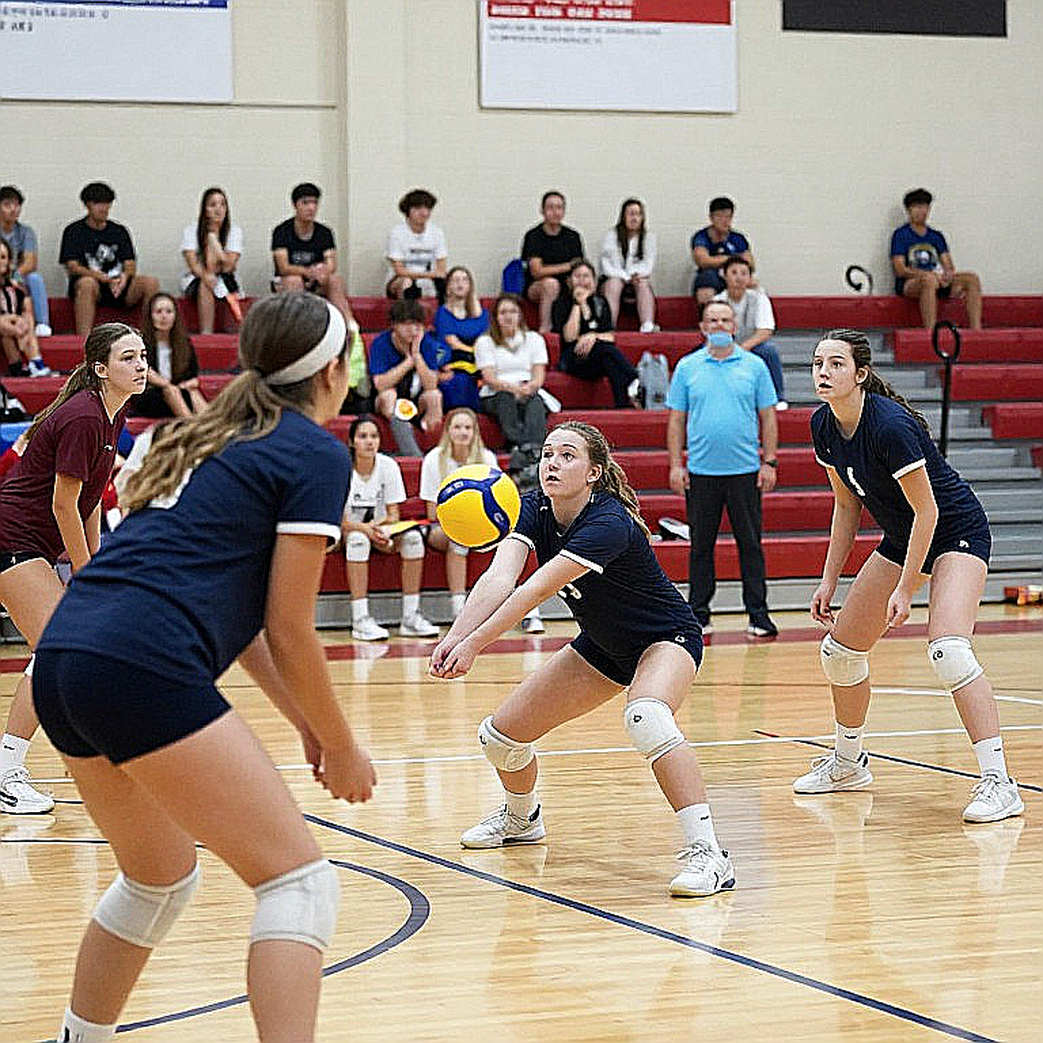
A good first touch lifts the ball to exactly the space in front of the setter's chest, about two and a half metres high, without spin. From there the setter has all three options: the wing, the back, or the quick middle. A first touch that pushes the ball outside the sideline near position two — still counted as a "successful reception" in official statistics — has in reality erased two of the three options, forcing the setter to send a high ball to the wing against a two-woman block. That difference never appears on the scoreboard. In the darkness of the press room, I learned to read between the questions — and between the numbers the scoreboard hides.
Over more than a decade, Vietnamese women's volleyball has moved from a position of "good enough to take part" to "good enough to apply pressure" in the region. The national women's team increasingly plays sets in which it leads opponents who once beat it easily. But it is precisely there that a certain kind of defeat repeats itself according to a suspicious formula: winning the first set, then losing momentum in mid-match when the opponent raises serving pressure. I call it the "mid-match fracture point" — not out of sentiment, but because it is structural.
The most-mentioned names — outside hitter Tran Thi Thanh Thuy, opposite Nguyen Thi Bich Tuyen, and setter Nguyen Thi Tra My — are all players at the end of the rally, where the light falls. Meanwhile libero Dang Thi Kim Thanh and the receivers at position two work at the start of the rally, where the ball has not yet become a point.
The match that left me with the most questions took place in a regional semifinal, when Vietnam's women's team won the first two sets and then lost in the tie-break. I went home and watched the footage three times, just to count one thing: how often the team lost the point straight off the opponent's serve.
In the two sets won, Vietnam's good first-touch rate sat at a steady level, around six in ten rallies. By the third and fourth sets, that figure dropped to roughly four in ten. But the more important point lay elsewhere: when the good first-touch rate fell, the number of attacking options fell with it. In the first two sets, the setter could distribute to the wing, the back and the quick middle. In the last two sets, almost every ball funnelled to position four — where the outside hitter had to solve it against a double block.
There is one detail I consider the centre of the whole match, at the seventeenth minute of the fourth set. The opponent served a heavy topspin ball into the gap between positions one and six. Vietnam's libero read the direction, moved early, but the ball landed just in front of her knee. She lifted it with both forearms and it flew back toward the stands. No point. But two seconds later, I noticed the setter never turned to look at the libero. She simply waved a hand, signalling the next ball. That silence told me more than any shout could.
The setter of a regional-level women's volleyball team works in a very narrow space. She has to read three things in the same instant: the quality of the ball just lifted, the position of the opponent's block, and the psychological state of her outside hitter. When the first touch is stable, that space widens, and she can play the kind of volleyball I love most: control volleyball. When the first touch declines, that space contracts to a single option, and she is forced to push responsibility onto the spiker.
I once thought a strong outside hitter was what decided how far a women's volleyball team could go. After thirty-three years of reading and writing about sport, I have revised that view. A strong outside hitter helps you win the matches you were supposed to win. But a stable first-touch system is what keeps you from losing the matches you were supposed to win. Those are two different things, and the scoreboard never distinguishes between them.
Looking at the leading women's teams in Asia, I see a clear pattern. The teams that keep a steady rhythm are not the ones with the tallest outside hitter, but the ones whose first-touch system fluctuates the least. They accept safer passing, less flamboyant setting, but a lower rate of consecutive lost points. In a five-set match, that stability is worth more than a few beautiful spikes.
That is also why I want to talk about the least-mentioned factor: squad depth at specialist positions. A women's volleyball team with two qualified dedicated receivers can rotate when one drops form. A team with only one libero of the required standard will depend on whether that player can hold her stamina through the whole tournament. In concentrated tournaments of seven to ten days, with almost one match a day, this is a life-or-death variable.
The ball at position two — the cross-court receiving spot, the one that absorbs serves aimed at it — is where I watch most closely from the stands. A good first-touch player at this position does not need height. She needs quick feet, a low body, and a mind that knows where the ball is going in the first two-thirds of a second after the opponent makes contact. That skill cannot be taught in a short training camp. It is accumulated over thousands of sessions, and it is almost never mentioned in the news.
The block is also a place that hides information. Watching the footage again, I paused on rallies where our team gave up points to a ball sent out the back. In the first two sets, Vietnam's two middle blockers read the direction of the set and moved early. In the last two sets, their footwork clearly slowed. The cause was not technique but stamina and psychology: when a team is behind, middle blockers tend to wait rather than commit, and a waiting block almost always loses to a quick attack.
I have written about the mental state of a collective as a tactical parameter, and in women's volleyball this parameter shows most clearly in how a team reacts after consecutive lost points. A team can lose three points in a row because its first touch dips, but how it walks into the fourth rally is what separates an unripe collective from a mature one. In the semifinal I mentioned, after each run of lost points, the setter was the first to clap, and she did it exactly one beat before the referee signalled the serve. It is a small behaviour the camera does not film, but it says the team still held its mental structure inside the storm of points.
I do not want to turn these observations into personal reproach. Those girls give everything under conditions that are not always fairly rewarded. But if we truly want Vietnamese women's volleyball to go further, we have to start talking about the system, not only about individuals.
Here I want to say plainly something that may make people uncomfortable. The way the media and fans treat Vietnamese women's volleyball has a structural blind spot: we reward brilliance and pay for image, but we run the system on different values.
The commercial value of an outside hitter who scores twenty points a match is real, and there is nothing wrong with her being sponsored, put on covers, paid what she deserves. But competitive value — the thing that actually decides a medal — often lies with a player the audience does not remember. When a women's volleyball team loses, the public's first question is always: how did the outside hitter play today. The right question should be: what percentage did the team pass.
There is another paradox. We praise the endurance of female athletes, yet we build leagues and training regimes that assume they can bear the same load as men without adjustment. Equality does not mean forcing women to endure more to prove their worth. Those quiet women do not need glory; they need a society that knows how to look. And gender equality in sport is a match with no final whistle.
What I want to see next season is not an outside hitter scoring more points, but a more stable first-touch system. Once that foundation is built, beautiful spikes will naturally have ground to bloom. I write for those who have never appeared in the sports pages — for the receiver at position two, for the libero forgotten behind the block, for the girl kneeling in the corner of the corridor rehearsing a receive with no ball in hand. If one day fans start counting first touches as much as they count spikes, Vietnamese women's volleyball will turn a different page.

Cầu thủ liên quan
Bài đề xuất
Estonia stun hosts Finland 3-2: Pool C closes on a data discrepancy2026-09-20
Vietnamese Volleyball Through the Data Lens: How Perfect-Pass Rate Exposes Tactical Blind Spots2026-09-18
Asiad 20: Waiting for a Mark, and the Rhythm That Stopped at the Women's Volleyball Quarterfinal2026-09-22
Japan at the 2026 Asian Men's Volleyball Championship: World No. 6 and an Unmeasured Question2026-09-27
Poland Beats France in Four Sets to Retain the European Men's Volleyball Crown2026-10-10
Perfect-Pass and the Spike Illusion: The Real Variable Behind Every Volleyball Set2026-09-14
Bài đề xuất
Budapest, Where the Likhatskyi Brothers Touched Their First Gold in the Silence of the Sand2026-10-10
Indonesia Targets Bronze at the 2026 Asian Games: A Goal Standing on a Data Void2026-09-25
From NCAA to Beach Legends: 30 Years of Women's Volleyball MOP and Lessons for Vietnamese Sports2026-09-24
Japan and Iran Lead Pool at 2026 AVC Men's Volleyball Asian Championship2026-09-09
Thailand and the No. 50 Line: Reading the Third Set at the 2026 Asian Men's Volleyball Championship Quarterfinal2026-09-11
End-of-Set Collapse: Where Vietnam Women's Volleyball Lost the Match Against South Korea2026-09-19
Bài đề xuất
Vietnamese Volleyball 2026: The Merger With No Record2026-09-13
Beach Kings and Queens: Brasher/Cruz and Crabb/Dalhausser Crowned AVP League 20262026-09-11
Women's Volleyball at Asiad 20: China Wins a Third Straight Title, and What the Standings Don't Say2026-09-24
2026 AVP League Championship: Two Finals Decided at the Net, Where the Block Was Neutralized2026-09-11
Japan and Iran Lead Pool at 2026 AVC Men's Volleyball Asian Championship2026-09-09
Vietnam Women's Volleyball and the Uncounted Bottleneck: The First-Touch System2026-09-14
Bài đề xuất
Sitting at the Edge of the Court: Vietnamese Women's Volleyball and the Things Nobody Counts2026-09-14
China win women's volleyball gold at Asiad 20: Dominance with a data gap2026-09-24
Kentucky Beats Louisville 3-1: Brooklyn DeLeye's 22 Kills and the .079-to-.420 Hitting Turnaround2026-09-22
Beaten 0-3 by Chinese Taipei, Indonesia's Women's Volleyball Team Closes Asian Games 2026 in Sixth Place2026-09-23
Inside SMU's win over Pitt: the net, the balance, and a 38-36 set2026-10-10
India's Fate Rests on Oman-Bahrain; Japan Perfect at 2026 Asian Men's Volleyball Championship2026-09-27